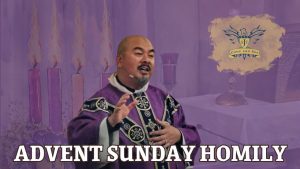
Father Chas Canoy
Watch the Homily
Listen to the Homily
As part of a sermon series marking the 1,700th anniversary of the Council of Nicaea, this homily reflects on the final section of the Nicene Creed: “I believe in one, holy, Catholic, and apostolic Church.”
This teaching explores the four marks of the Church and what they mean for our identity as members of the Body of Christ. Drawing from Sacred Scripture, the Catechism, and the witness of the saints, the homily explains how the Church is one with Christ, made holy by Him, universal in her mission, and apostolic through an unbroken line handed on from the apostles.
The reflection concludes with a message of Christian hope rooted in the promise of the resurrection and the vision of the heavenly wedding feast described in the Book of Revelation—a vision that also inspired the new apse mural at St. John the Evangelist.
This homily invites listeners to deepen their understanding of the Creed they profess each Sunday and to renew their commitment to living as members of Christ’s Church.
Read the Homily
This homily is part of a sermon series on the Creed, marking the 1,700th anniversary of the Council of Nicaea—the ecumenical council that gave us the Creed the people of God have professed faithfully throughout the centuries.
You may have noticed that the Creed is structured around four statements that begin with “I believe.” In the first three, we profess our faith in each Person of the Holy Trinity: the Father, the Son, and the Holy Spirit. Today, we turn to the fourth and final section, which concerns you and me—the whole family of God—the Church.
In this section of the Creed, we profess belief in “one, holy, Catholic, and apostolic Church.” These are known as the four marks of the Church, the defining characteristics that make the Church what she is as the Mystical Body of Christ.
The Church Is One
First, the Church is one. Jesus Christ is the Bridegroom who has only one Bride—the Church that He founded. Christ has made Himself one with her.
The Catechism of the Catholic Church quotes saints throughout history who testify to this profound unity. In paragraph 795, we read: “Christ and His Church thus together make up the ‘whole Christ’ (Christus totus).”
St. Augustine famously said:
“Let us rejoice then and give thanks that we have become not only Christians, but Christ Himself. Do you understand, brethren, God’s grace toward us? Marvel and rejoice: we have become Christ. For if He is the Head, we are His members. He and we together are the whole man.”
St. Thomas Aquinas echoes this truth, saying that head and members form, as it were, one single mystical person.
This is precisely what we celebrate at Christmas in the Incarnation. When God the Son entered into creation, He took upon Himself something He did not possess from all eternity: our humanity. And after His Resurrection and Ascension, Jesus did not shed that humanity. He brought our humanity into the very life of the Trinity.
Because Christ has united humanity and divinity in His very person, we are united with Him. We are not our own. As St. Paul reminds us, we belong to Jesus Christ. He is ours, and we are His.
Because we share one identity in Christ, we also share in His mission—to save humanity and make disciples of all nations. Through the Church, Christ is no longer limited to one place or one time. He continues His saving work in every generation and across the whole world.
The Church Is Holy
The second mark of the Church is holiness.
At first glance, this may seem difficult to believe given the sins and scandals that have marked the Church’s history. But the Church is holy not because of you or me. Thank God it does not depend on our personal holiness.
The Church is holy because of the One to whom she is united—Jesus Christ.
The Bride is holy because the Bridegroom is holy. The Mystical Body is holy because her Head is holy. Christ’s holiness is infinitely more powerful than our sinfulness. There is no contest.
Our sins are foreign to the Church’s true nature. They are antigens, and Christ’s mercy is the antibody. His mercy is infinitely stronger than our failures—but that healing can only occur if we remain united to Him through His Church.
This is the spiritual reality of the Mass. Christ’s mercy cleanses us; His grace strengthens us.
Jesus Himself explains this in John 15: “I am the vine; you are the branches. Whoever remains in me and I in him will bear much fruit, because without me you can do nothing.”
If we cut ourselves off from Christ through grave sin, the remedy is simple and merciful: return through the Sacrament of Reconciliation. Confession is the sacrament of His mercy. Jesus is not repulsed by sinners; He rejoices in their return.
As St. Paul writes in Ephesians 5, Christ gave Himself up for the Church to sanctify her, cleansing her so that she might be holy and without blemish. Jesus will complete the good work He has begun in every soul that remains united to Him.
The Church Is Catholic
The third mark of the Church is that she is Catholic—that is, universal.
The Church is for everyone: Jews and Gentiles, men and women, saints and sinners, people of every nation and every age. Because the Church is universal, she has existed from the moment Christ founded her—not from the 1500s or any later period.
The Church Is Apostolic
The fourth and final mark of the Church is her apostolic nature.
Jesus said to Peter, “You are Peter, and upon this rock I will build my Church, and the gates of hell shall not prevail against it.” He entrusted His authority to the apostles, and that authority has been handed on through an unbroken line of apostolic succession down to Pope Leo XIV and the bishops of today.
Even the failures of Church leaders throughout history have not destroyed the Church. God protects His Church not because of human perfection, but because of Christ’s union with her.
The Church’s apostolic foundation guarantees that the faith we receive today is the same faith handed on from the apostles—not the personal interpretation of any individual.
Our Hope in the Life to Come
We conclude the Creed with the words: “I look forward to the resurrection of the dead and the life of the world to come.”
This is why Christians can live with hope even amid division and suffering. This life is not all there is. Christ is coming again, and He will make all things new.
To conclude, we turn to the vision given to our parish’s patron saint, John, in the Book of Revelation—a vision that also inspired the apse mural at St. John the Evangelist:
“Then I saw a new heaven and a new earth…
He will wipe every tear from their eyes, and there shall be no more death or mourning, wailing or pain…
Behold, I make all things new.”
This is our hope. This is the faith we profess. Amen.