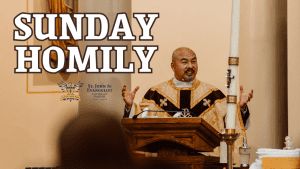
Father Chas Canoy
Watch the Homily
Listen to the Homily
In this homily, Father Chas reflects on the conclusion of the Jubilee Year of 2025 and the remarkable spiritual fruits that have flowed from it—renewed faith, deeper Eucharistic devotion, and a growing boldness among young people to publicly follow Christ. He also introduces the Extraordinary Jubilee Year of Redemption in 2033, marking 2,000 years since Christ laid down His life to redeem humanity.
Through clear teaching and pastoral insight, Father Chas explains the meaning of redemption, the covenantal nature of baptism, and the Eucharist as the sacramental consummation of our union with Jesus. He connects these truths to the Church’s mission today, including the National Eucharistic Revival and the Walk With One Initiative, encouraging parishioners to intentionally accompany others toward Christ.
This homily offers a compelling invitation to remember our baptismal identity, recommit to Sunday Eucharist, and live fully as members of God’s family.
Read the Homily
Father Chas:
Just a few days ago, on Tuesday, January 6th, Pope Leo closed the Holy Door of St. Peter’s Basilica to mark the end of this historic Jubilee Year, the year of our Lord 2025. These Jubilee Years ordinarily come only every 25 years, unless the Holy Father calls for a special extraordinary one.
And in fact, Pope Leo has already announced that there will be an extraordinary Jubilee Year in 2033, calling it the Jubilee Year of Our Redemption. So what are we commemorating in this Jubilee Year of Redemption? Well, the Latin root for redemption is redimere, and that means “to buy back.” To buy back. So with the great price of His precious blood, Christ has redeemed humanity.
Jesus has bought you and me back from the ruler of this world, freeing us from the slavery of sin and death through the Paschal Mystery of His passion, death, and resurrection. So why 2033? Well, how old was Jesus when He laid down His life for us? Thirty-three. That’s why 2033. We are celebrating the 2,000th anniversary of our redemption.
Before I get thinking too far ahead, this Jubilee Year of 2025 that we just concluded has been a year of extraordinary graces. Recent data from Harvard, Barna, and Pew Research shows increases in interest and commitment to Jesus and the Catholic faith among Gen Z, particularly among young men in their teens and twenties.
With many parents of Gen Z having cast aside the faith given to them and not raising their children to go to church, these young people are discovering on their own a powerful life force with which they never grew up or to which they were never regularly exposed.
And the young aren’t as afraid or embarrassed to share that experience. Perhaps you’ve noticed how readily young sports figures today, in their interviews, are much more inclined to first and foremost recognize and thank God for what the Lord Jesus has done in their lives—redeeming them from a world that has eaten many of our kids alive and freeing them instead to excel in their life endeavors.
Just this past Friday, Father Randy and I were watching the end of the Indiana–Oregon game. After IU’s victory—my alma mater, which for so long was used to being a bottom-dweller—perhaps some of you saw Fernando Mendoza thanking God repeatedly for the blessings that enabled him to be where he is today as a young man.
Father Patrick Hyde, the pastor over at St. Paul Catholic Center at Indiana University, where I went to Mass during college, told me that Mendoza is the real deal. He sees him at Mass every Sunday. Mendoza even brought the Heisman Trophy to St. Paul’s to show the Dominican friars and told them, “You are a major reason why this happened.”
That boldness in faith is not an anomaly among young people today. And perhaps you’ve noticed that even here in Jackson—certainly not known as a hotbed of young adults—there are more young people coming to church. I don’t think that trend is unrelated to the graces of this Jubilee Year.
Also, during this special year of 2025, we concluded the National Eucharistic Revival here in the United States, which has deepened our relationship with Jesus in the Eucharist. That deepened relationship urges us to share our faith with others and to draw a hurting humanity back to the Sacred Heart of Jesus, the Divine Physician who desires to heal them.
From the National Eucharistic Revival was born the Walk With One Initiative, an effort to make evangelization simple. Pray for and build a friendship with just one person and spiritually accompany them to an encounter with Jesus Christ. See that person as the one with whom you concretely live out the commandment to love your neighbor—week in and week out. I hope that in this new year, each of us will focus on the one person the Holy Spirit has placed on our hearts. Amen.
Another grace of this Jubilee Year was our parish pilgrimage to Rome. Many parishioners joined the millions from around the world who traveled there during this special year. While most of our parish families couldn’t make the trip, I wanted everyone to share in the graces of that pilgrimage.
Not only did we bring and pray for your intentions at each of the major basilicas, but I also wanted to bring something back for you. Since Jubilee Years are ordinarily 25 years apart, I decided to splurge and purchase enough rosaries so that each church-going parish household could receive one.
Some of you have already received one for special occasions or parish recognition. But on the Wednesday of the papal audience, when Pope Leo blessed the religious items people had brought, I was carrying hundreds of rosaries in two full backpacks—one on my back and one on my front. It was heavy, and I’ll just say I was very grateful to be a man.
I wanted to carry them myself because there was a spiritual significance in bringing each and every one of you with me to St. Peter’s for the Holy Father’s blessing and the Holy Doors. And just because I had to buy hundreds doesn’t mean I went cheap. These aren’t plastic or cloth rosaries. They are wooden, and each of the four Our Father beads is a medal dedicated to one of the four major basilicas we prayed in—St. Peter, St. Paul, St. John Lateran, and St. Mary Major.
At the end of Mass, helpers will hand out a rosary to every household who would like one. If you take one, I ask that you promise—hopefully as a family—to pray at least one rosary for me. There’s also a small guide included for those who may not be familiar with praying the rosary.
One of our parishioners also anonymously gifted each household a book called The Seven Pillars of Catholic Spirituality. The seventh pillar is the rosary, and I encourage you to read that chapter—just fourteen pages—as part of your prayer life this week.
Pivoting back to today’s feast, remember what we celebrate during Christmas time: the Incarnation. God the Son, the second person of the Trinity, became man. Divinity and humanity were united. The Divine Word wedded Himself to humanity.
As we celebrate the Baptism of the Lord, remember that the one who needed cleansing was not the Son of God, but the humanity He assumed. In His baptism, Jesus sanctified the waters, preparing the way for us to be cleansed and baptized into the one Body of Christ, the Church, and made sons and daughters of God.
By virtue of being human, we are made in the image and likeness of God—a tremendous dignity. But it is an entirely different thing to be a son or daughter of God. That comes only through our union with the only begotten Son, Jesus Christ, in baptism.
In baptism, we are adopted into God’s family. We enter a covenant, not a contract. A covenant is an exchange of persons. Marriage is the primary image God uses to describe His relationship with us. That is why heaven is described in Revelation as the wedding feast of the Lamb.
Baptism is our betrothal to Christ. The Eucharist is the consummation of that union. “Whoever eats my flesh and drinks my blood has eternal life,” Jesus tells us. Each Mass renews this covenant as the Church, Christ’s bride, receives His Body and becomes one flesh with Him.
That is why first communicants wear white—symbolizing the bride. And that is why we should always remember our baptism day. I was baptized on December 30, 1972—the day I became part of God’s family, a beloved son in whom the Father is well pleased.
Let us pray.
Dear Jesus, help us to remain faithful to the covenant we entered with You in baptism. Each Sunday, You call us to renew that covenant through the Eucharist. May we always keep the Lord’s Day holy. Amen.