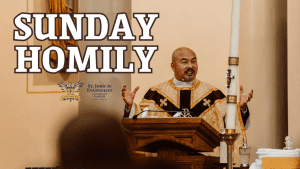
Father Chas Canoy
Watch the Homily
Listen to the Homily
Father Chas explores how sports can reflect the journey of life while reminding us not to lose sight of our ultimate purpose. Drawing on Scripture and the witness of faith-filled athletes, this homily encourages a renewed reverence for the Word of God as the foundation for unity, discipline, and true fulfillment.
Read the Homily
Speaker: Father Chas
All right. All glory to God. It was great to hear Fernando Mendoza say that over and over again—win after win, interview after interview—“All glory to God.” And for those who do not follow college football, Fernando Mendoza was the quarterback for the Indiana Hoosiers, who won the national championship this past Monday. I never thought I would see the day my alma mater would win the national championship.
You have heard of Michigan being the winningest program in Division I college football. Well, entering this year, Indiana was the losingest program in Division I college football. Apparently, Northwestern now holds that distinction.
I think many of us like to see the underdog succeed. It is much easier to cheer for the underdog when you have a wonderful young man like Fernando Mendoza leading the team. That final game was truly epic. It was the fourth quarter, fourth and five, Indiana in the red zone, with the championship on the line. Mendoza hikes the ball, dodges, twists, runs over a linebacker, and then takes off like Superman across the goal line. It would be difficult for any future movie to capture that moment better than how it actually unfolded.
Why do we love sports so much? A large part of it is the drama that can unfold. But being involved in sports can also teach us many lessons about life. Sports can be a microcosm of the journey of life itself. A microcosm is a situation that encapsulates, in miniature, the qualities of something much larger. Sports often do exactly that.
That is part of the reason I enjoy playing golf. One round of golf can be a microcosm of life. There are exhilarating highs—striping one down the middle, making putts for birdie—and there are moments when you hit into the woods, out of bounds, into the water, or into the bunker, and it takes several strokes to recover. How are you going to react in those moments? Will you let them derail the rest of your round?
The ups and downs of golf have taught me how to deal with the ups and downs of life itself. We can learn many life lessons through sports. The problem arises when we lose sight of the macrocosm—the bigger picture, the ultimate meaning of life—for which these smaller experiences are meant to prepare us.
If we mistake the microcosm for the macrocosm, we set ourselves up for disappointment and regret. It would be like making golf the meaning of my life instead of enjoying it as a gift: a way to enjoy God’s creation, fellowship with friends, develop virtue, and be renewed for the real work of living. When we make improvement at golf the ultimate meaning, we mistake the means for the end.
When we lose sight of the bigger “why,” we get into trouble. The things of this world can never fully satisfy what God has made us for. What profit is there to gain the whole world and forfeit one’s soul? What profit is there to win the Masters but lose your soul?
What I admire about Mendoza is that, as dedicated as he is to football, he does not allow it to eclipse the bigger picture. After winning the championship, he said, “I don’t praise God because we won. I praise Him because He’s worthy, no matter the outcome. Tonight just happened to be a blessing.”
On the Today Show, Mendoza spoke openly about his Catholic faith, his regular attendance at Mass, praying the rosary, and the role his parish community has played in strengthening his faith. He gives God all the glory and praise for what He has done in his life.
Even at the sport’s biggest stage, Mendoza keeps the bigger “why” in focus. He is a powerful witness not only for young people, but for all of us who can easily become consumed by the smaller picture.
St. Paul, in the second reading, urges the Church to be united in mind and purpose. He laments divisions among the faithful and reminds us that we are one in Christ. In a world filled with division, unity among Christians is essential.
Sports can teach us something here as well. They teach us how to be part of a team. We are part of something much bigger than ourselves. Ultimately, there is only one team that truly matters: the communion of saints. To claim victory, we must rally under our coach and teacher, Jesus Christ, who is the way, the truth, and the life.
How do we achieve that unity? We must know the playbook and focus on execution. The playbook is the Word of God. On this Word of God Sunday, I encourage you to make Scripture the strong foundation of your daily life.
We live in an age of distraction and information overload. To remain focused on loving God and neighbor, we must live lives of intentionality, discipline, and commitment. Our identity is not rooted in worldly ambitions but in being sons and daughters of God, disciples of Jesus Christ, and saints in the communion of saints.
To unleash the power of God’s Word in our lives, I offer three practical steps. First, cultivate a greater reverence for the Word of God, recognizing it as the words of eternal life. Second, see the Word of God as our refuge and defense amid the world’s chaos. Third, incorporate the Word of God into your daily prayer through daily readings, reflection, and meditation.
Know God’s playbook—and execute.