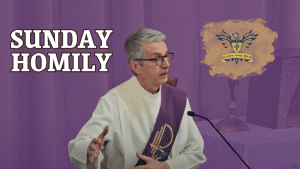
Deacon Dave Etters
Watch the Homily
Listen to the Homily
A reflection on the Gospel story of the Woman at the Well reminds us that the true source of every blessing in our lives is the love of God. In this message from St. John the Evangelist Catholic Church in Jackson, Michigan, we explore how Jesus sought out one broken soul in Samaria and transformed her into the first evangelist in John’s Gospel.
Read the Homily
Good afternoon. I recently received a call from a really good friend of mine. We have been friends for over forty years. Over the years we have gone on many trout fishing trips together and spent a lot of time talking about life. He is a very good friend and someone who has been very successful in his career. He is retired now and has done very well for himself. During our conversation he said something that really struck me. He said, “Dave, I have been so blessed by God, and I don’t know why.”
He has been through four serious cancers. Doctors at the Mayo Clinic have even said that a couple of them were cases they had rarely seen before. He has undergone surgeries in New York City that lasted twelve hours at a time with teams of specialists working on him. Yet through everything he has endured, he continues to live with a deep sense of gratitude. As we talked, he said, “Maybe the reason God has blessed me is because I give to missionaries.” I wanted to respond immediately, but I checked myself and simply allowed the conversation to end gracefully. What I really wanted to say was this: giving and doing good things are certainly virtuous actions that can bring blessings into our lives, but the real reason you have been blessed is much simpler than that. You have been blessed because God loves you. That is the root cause of every blessing that comes into our lives. God created us out of love. He made us to be loved by Him and to love Him and one another. That is what life is all about.
I want to thank Father Randy for proclaiming the Gospel today. How many of you thought it was long enough? It is a long Gospel reading, almost the entire fourth chapter of the Gospel of John. But it is a wonderful story. However, as long as the reading is, the editors of the lectionary actually left out one of the most important verses in the passage. At the beginning of the story we are told that Jesus was traveling from Judea in the south to Galilee in the north. And the verse says something very important: “Jesus had to go through Samaria.” That line should immediately set off lights and alarms in our minds. Most devout Jews at that time would do everything possible to avoid Samaria. When traveling north from Jerusalem, they would actually cross the Jordan River and go up the eastern side rather than pass through Samaritan territory. They wanted nothing to do with the Samaritans because they considered them unclean and unworthy of association. But Jesus went straight through Samaria. The Son of God had an appointment, and He was not afraid of scandal or ritual impurity. He had an appointment with a single soul. He had an appointment with a woman, and He loved her. That is why He went.
Think about that for a moment. Here we have the Son of God, the second person of the Blessed Trinity, sent into the world on a mission for the salvation of humanity. He came to proclaim the Kingdom of God, to suffer and die on the cross for our sins, and to rise from the dead so that we might have eternal life. Yet in the middle of that enormous mission, He takes time to meet one person. One woman. The love of God is immeasurable and beyond calculation, and it is the same love He has for each and every one of us. He loved that woman even though He knew everything about her life. He knew every flaw, every failure, and every broken piece of her past. As St. Paul reminds us in the Letter to the Romans, Jesus died for us while we were still sinners. He gave His best for us when we were at our worst.
Jesus arrives first at Jacob’s well. That detail tells us something very important about the way God works. It shows the primacy of grace. Grace comes first. God comes to us before we ever come to Him. Everything in the spiritual life begins with God’s initiative. Then, when the woman arrives, Jesus begins a conversation with her. This in itself was shocking, because Jewish men did not publicly speak with women, and certainly not with Samaritan women. Yet Jesus enters her world, even though it was a messy and broken world. She had five failed marriages and was living with a man who was not her husband. She was a Samaritan and an outcast in many ways, yet Jesus meets her exactly where she is.
In a masterful and compassionate way, Jesus begins to reveal her life to her. At the same time, He offers her something greater than anything she has ever known. He offers her living water. As the conversation unfolds, she begins to realize that He is not merely a prophet. Eventually Jesus tells her plainly, “I am he, the Messiah, the one speaking with you.” When she realizes who He is, something incredible happens. She leaves behind her water jar, which symbolizes her old life, and runs back to the town. She begins telling everyone she meets, “Come and see a man who told me everything I have ever done. Could this be the Messiah?” Because of her testimony, people begin coming out of the town to meet Jesus for themselves. They listen to Him and many come to believe.
In the Gospel of John, this Samaritan woman becomes the very first evangelist. And she is a woman. The Gospel writers did not try to sanitize or soften the story to make it more acceptable to their culture. They simply told the truth. In fact, the first person to witness the resurrected Christ was also a woman—Mary Magdalene. In that culture, the testimony of women was not even considered credible in a court of law, yet God chose them to be the first witnesses. God does not operate according to human expectations. He operates according to love.
In the 1960s Pope Paul VI wrote an encyclical called Evangelii Nuntiandi. In it he said that evangelizing is the grace and vocation proper to the Church, her deepest identity. The Church exists in order to evangelize. Evangelization has two dimensions. The first is preaching and teaching the Word of God, bringing people who are far from God back into relationship with Him. The second is the celebration of the Mass. The Mass is not separate from evangelization; it is at the heart of it. Here on this altar Jesus Christ becomes truly present—Body, Blood, Soul, and Divinity in the Blessed Sacrament. When we receive Him in the Eucharist, He empowers us to become little Christs in the world. We are sent out to proclaim the Good News of Jesus Christ and to bring people back to the well, just like the Samaritan woman did.
And the well is right here. When we gather for Mass, something extraordinary happens. The veil between heaven and earth becomes incredibly thin. In this church, in this community of Jackson, we participate in the sacred mysteries of Christ’s life. The story of salvation unfolds before us—from the garden, to the cross on Good Friday, to the resurrection of Jesus Christ who appeared to Mary Magdalene as the gardener on Easter morning. Every Mass draws us into that same mystery. We join with the saints and angels who adore the Lamb of God in heaven. This is not merely symbolic. It is real. The veil between heaven and earth is paper thin.
And from this altar we are sent out into the world. We are sent to tell others what God has done in our lives. My prayer is that we continue to grow in the grace of God, that the fire of His love fills our hearts, and that we go out and tell everyone about Him, just like that Samaritan woman who ran back to her town and said, “Come and see.” Amen.