Father Randy Koenigsknecht
Watch the Homily
Listen to the Homily
What Makes a Family Holy
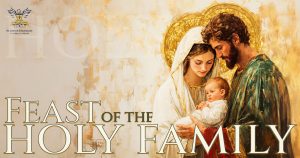
In this homily, Father Randy reflects on the Feast of the Holy Family and challenges the common assumption that holiness comes from perfection. Instead, he emphasizes that holiness begins when families intentionally invite God into their daily lives.
Drawing from personal experience and pastoral insight, Father Randy explains how God is not deterred by imperfection but is drawn to it. He highlights the central role of Sunday Mass, the power of shared family prayer, and the freedom families have to discover prayer practices that truly bear fruit in their own homes.
This reflection reminds us that holiness is attainable for every family—not by comparison or performance, but by consistently welcoming God as a living and active member of the family.
Read the Homily
As a holy family. So Jesus, from this moment on, he will go, and for many years he is going to live with his family, as a member of the family with them.
And so as we begin our reflection today, I have a fun question for all of you. And that is, what makes the Holy Family holy? Now the obvious answer might be, well, it is the people that make it up. They are holy.
Now, I mean, you are not wrong. You cannot really get much better than Jesus, Mary, and Joseph. Like number one all-star picks right there. They are like the Dodgers of families. You are not going to beat them.
But our families are also called to be holy. And so I propose that it is not actually the members of the family that make them holy. It is rather the individual members of the family who are inviting God to be at the center of their lives. That is what makes us holy.
Not that we can out-duel Mary and Joseph and Jesus, but we can invite God to be at the heart of our family like they did, like Jesus would have experienced throughout all of his life—learning and growing in faith.
And so a family united around God, where he is involved in all the various parts of their family life, where God is welcomed, where he walks with them and talks with them.
You know, we can often treat God just kind of like a kindly uncle. Like we talk about him every now and again, and maybe he comes over every so often.
But we are looking for something more—that God is an actual member of our family, someone who we talk about and someone who we talk to.
Through baptism, God invites us to be members of his family. And so we are called to likewise welcome him into our families. And as we learn to do that over time, we are changed. Our families not only become holy, but the individual members who make them up are transformed.
And that is how all of us, all of our families, can be holy alongside the one Holy Family.
So what does that look like concretely?
I believe it starts when we realize that God is not afraid of the messiness in our lives, the messiness that we sometimes have in our families. We have to make peace with the fact that our families will never be perfect simply because we belong in them.
And last time I checked, I am not perfect yet. I still sin. I still fail to love my family as I ought.
But rather than seeing that as something that causes God to draw away from us, to draw back from our families, we remember that that is precisely what draws him to us. Jesus came to call not the righteous, but sinners.
That means that so long as we are willing to recognize that our families are not perfect, that we could be more holy and more devout, God comes close.
It is only when we say, “I think we have it figured out. I think we are doing pretty good,” that we stop growing. That is the only obstacle that we can put up.
And so the first step for us in growing and becoming holy families is simply inviting God in—bringing to him all the ways that your family is not perfect and asking him to help.
Ask for that next step. What does it look like for us to grow closer to you as a family? What can we do?
Some of those steps are universal. Every family is called to them. The biggest example of this is committing to coming to Mass every Sunday.
Mass is the place where we gather together as God’s family. The closest analogy we have to that in our family life is the mealtime, like a family meal.
There is a power in gathering together intentionally as a family, being with one another, and sharing a meal. It is something that is always worth doing, even if it is difficult, even if it is not that fun.
I experienced that myself this past Christmas. You heard Father Chas talk about how bad the flu has been. Pretty much all of my family had the flu.
So that meant after the Christmas Masses, I was supposed to come home for Christmas lunch. And I did not really want to go that much. I did not want to be around them, and they did not really want to be around anyone either. The flu is miserable.
But it was important to do it. It was not the most fun. It was not the most jolly Christmas I have ever had.
But it was worth it to be with them nonetheless, because they are important to me, because I love them.
And we can apply that same attitude to Mass. The reason we come to Mass each week is because we want God to be a regular part of our life. We want to be with him.
This is the time we set aside for him because he is important to us, because we love him.
Sometimes coming to Mass requires more work. It takes extra steps. You are on vacation. You have to break with the plans a little bit. You have to fit it in with sports schedules or whatever else is happening.
But God is worth it.
The same way it was worth it for me to come home to be with my parents. I love them. It is important.
That step is a universal calling. Every family is called to that standard.
But there are other steps that are not as standardized. They are more unique to every family. And this is where I place family prayer time.
Just as each person’s relationship with God is unique, God speaks to all of us in different ways and works with us in the way that best suits us. God’s relationship with every family is also unique.
There is no single best model for family prayer. No one perfect formula.
Some families love praying the rosary. They feel deeply connected to God through Mary, and it bears great fruit.
Other families try that and find it dry and difficult. But that same family might find great fruit praying together at night, having each child offer an intention for the next day.
In my own family, our prayer life was very simple. Once a week, my parents sat all ten of us kids down. We prayed a decade of the rosary, read the Sunday readings, and then went around the circle saying one thing we were thankful for.
I remember many times as a kid not wanting to do that. I remember crying over not wanting to say what I was thankful for. It was simple.
But it was powerful.
It was a concrete way of inviting God to be an active member of our family. And it was those small things that formed my prayer life over time.
We can get caught up asking, “What is the best thing we can do as a family for prayer?” And then we start looking at everyone else. We look at social media and see all these great Catholic families doing ten devotions a day.
If that works for them, praise God. But if it does not work for you, you do not need to do it.
Look for what works for your family. Look for where the fruit is.
God is not spending time with us because we are so holy or because we are doing all these impressive things. He wants to be with us.
That is what makes us another holy family.
It starts with that first move: “God, I want you to be a part of my family. I want you to be a more prominent member of my family. Show me the next step.”
For some, that means committing to Mass more often with the goal of every Sunday.
For others, it means starting some form of communal prayer or adjusting what you are already doing.
It might be as simple as praying together on the way to school, on the way to the store, or saying prayers before meals.
The beauty of this feast is that it shows holiness is possible for all families.
We hold up the Holy Family not because they achieved an impossible standard, but because they show us what really matters—intentionally inviting God in and being willing to take the next step with him on the journey toward holiness.