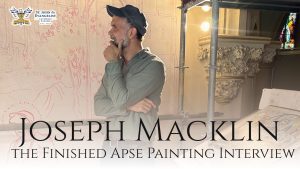
Father Chas Canoy, Joseph Macklin, & Michael Philpott
Watch the Interview
Listen to the Interview
This special parish event marked the unveiling and reflection on the newly completed sacred mural at St. John the Evangelist Catholic Church. Led by Father Chas, the evening opened in prayer and continued with thoughtful conversation alongside the artist, offering insight into the creative, theological, and spiritual journey behind the work.
Rooted deeply in Catholic tradition, the mural draws inspiration from the great masters of sacred art while speaking powerfully to the life of the Church today. The artist describes how prayer, Scripture, and the support of the parish community shaped every aspect of the project, allowing the work to become not only visually striking but spiritually formative.
More than decoration, this sacred art is intended to prepare hearts for the Holy Mass, deepen reverence for the Eucharist, and invite all who encounter it into contemplation and prayer. This project reflects the Church’s historic role as patron of beauty and witness to the Gospel through sacred art.
Read the Interview
and great to have JTV here covering the the this event so thank you Bart let’s pray father the son of the Holy Spirit amen dear Lord we thank you uh that we are right now living Tabernacles of uh you that that Union you desire with us and we’re still in that ecstatic 15 minute period probably
where we are living tabernacles, just like Our Lady was as the Ark of the Covenant. And so help us to be aware of that, the dignity of each and every, the dignity you give to each of us as we are all made in your image. And so bless this time together with Joseph as he elucidates for us the work that he has done for us with such this labor of love. And so we ask this with the…
intercession of our lady as we pray hail mary full of grace the lord is with thee blessed art thou among women and blessed is the fruit of thy womb jesus holy mary mother of god pray for us sinners now and at the hour of our death and name the father the son and the holy spirit got it on we’re not used to doing this kind of format so bart is but hey we’re not
Do you need the other mic? Here, let me take a look at it. You got to speak into it. All right, well, thanks, everybody, for coming. And so what we’re going to do here is just spend about maybe about 20 minutes. We’ve just got some questions we prepared here for Joe, and then we’ll leave about 10 minutes for some of the questions that you may have submitted. So…
All right, first, so Father gave a really good kind of rundown of the composition of the piece, you know, within the limited time that we had. But one thing that we’ve heard a lot from people is just like, how did Joe come up with this? How did, like, this all fits together, and it’s amazing. So could you just walk us through just, you know, a couple minutes on the creative process as you designed it from initial conception to composition? Sure.
Thanks, I didn’t come up with this so you guys speak into it Speaking okay So I didn’t come up with this Is really a culmination of plenty of conversations with father Chaz Michael as well
years ago. And even the image that exists is pulled heavily from and is influenced by a lot of prior creations from sacred artists, from sacred art tradition in the Catholic history. So, I mean, I just took from what existed and by the grace of God, what is shown up there
It seems to work okay. I think that’s the understatement of the season.
So, you know, as Father also has pointed out, and, you know, you and I have had a lot of discussion about, right, is that beyond a piece of art, this is part of prayer, right? And so just how do you, when you were up there on the scaffold in your painting and you’re really going into it, like what is your hope for how it’s going to function, right, in the life of our community and worship, you know, just everyday moments, that type of thing? Yeah.
So the project was manifested greatly through showing up and making sure that I was able to take on the work for that day and throughout the completion of the project. And so I came about through prayer, and really I’m hoping that those who see it, who come into contact here with the Holy Mass today,
that they are prepared as well and that they come to the Lord’s table in prayer and in expecting to bring their best selves to the Mass. So, yeah, if this project can inspire, you know, deeper self-reflection and deeper sense of prayer, that is, that’s, I couldn’t ask for more. Okay.
And then, so you had mentioned in your first answer, you know, that you were drawing on a lot
the historical artistic traditions of the church that informed you um could you go go into go put your your teacher hat on a little bit for a second and tell us specifically what some of those artists were i mean you know maybe uh not many people know who they are but they might be inspired to look them up and and and engage in and sacred heart
I was an awful teacher, so. So Jan van Eyck, Blessed for Angelico, were two of the primary artistic influences for this project. There were two artists that lived back in the late 1300s, actually born about five years apart from each other. So when Father Chaz brought up those two,
two powerhouse Catholic artists. It was a bit of a tall order to try to follow in their footsteps, but yeah, and really…
You know, when you are trying to pull from that heritage and that tradition, that level of skill, it was absolutely just imperative that, you know, I took the project up in prayer and just really trusted and knew that God was going to see this through.
Just to give you some context, Van Eyck is that famous artist who did the Adoration of the Mystic Lamb, so the Ghent Altarpiece, which by the way has a new home. And just to give you an idea of the pricelessness of these art, of this type of art, which I think Joe has world-class talent that rivals the masters, right?
the government, I think it’s Belgium, that I don’t know if it’s on the country level or a
private foundation. You know, some of the arts that’s been protected, the state has taken over in some of Europe because they’re so priceless. And they spent $35 million just for the security system and the bulletproof glass to protect this priceless piece of art. And if you look at the Ghent altarpiece and the Adoration of the Mystic Lamb, you will see an incredible resemblance to what we see before you now. FYI.
And Ghent is spelled G-H-E-N-T if you want to look it up. Yes. Okay, so just to shift a little bit from the art and then the talk, again, you kind of touched a little bit on the journey, right, that you as an artist had. So I think a lot of people here probably saw one of the more recent videos that the diocese put out. And I know in some conversations I’ve had, a lot of people were very touched by that.
can you, you know, we got a little snippets. Can you share a little bit more about like that, that connection between your spiritual life, the spirituality and the prayer and the experience of, of not just this painting, but all of your art? I guess I see the, um, the, the work, the, uh, the, the artistry is, um, just kind of, uh, being a partner with, with God. Um,
And, you know, it’s easy. I guess I’m blessed because it’s easy to take the work that I’m doing here behind the tabernacle at St. John’s or maybe even at home. And the project is easily identifiably Catholic.
it’s meant, and I think it’s obvious that the project that is being produced is certainly focused on God. So to just dovetail the spirituality aspect
In life, in my existence, with that of the professional aspect is, I mean, I’ve got it pretty easy. So, you know, I think St. Therese up there, you know, is…
she’s a powerhouse for a lot of those that don’t have it as easy as I do. And so I’m grateful that she has made an appearance within the composition. But yeah, it’s easy for me. I can wake up with daily prayer. But one thing that I’m indebted to Father Chaz is
in this, this, the community that has supported this project is, um, it’s brought me to, to, to the foot of the cross, but, but to the pages of sacred scripture and to, to be able to dive into the, the life-giving word on a daily basis is something that I certainly wasn’t doing before I came to this project. So, um, my hope is that that continues, um, because, um,
You know, I do think over the course of the last seven years, I’m in a much better spiritual place in my life. And so I’m definitely indebted to Father Chaz and for this project. But yeah, so kind of rambled a bit, but hopefully…
No, and two, just to give testimony and such, I’ve had the opportunity to really get to know you over this last year. And I’m very edified by you and some of our conversations, which really inspired me in my work. And I think it’s good to see the example of somebody who can marry you.
your spirituality and the work that you do and integrate them. And it’s an example for all of us. So thank you for that, Joe. So FYI, Joe’s day often started at 3 a.m. in the morning. He would paint. There’s something about the stillness of when the whole world is asleep, there is a mystical…
prayerful um spirituality that joe has that allows him to really flourish while everything is still and silent and then he’s often here i didn’t see his working during mass as a distraction at all because i knew that his heart was united
with what was going on at Mass. And that what he was doing up there during daily Mass was a holy work, a sacred work. So it was awesome to see you up so early, often here late. I mean, it was surely full-time throughout this entire calendar year. Just to give you some context, the Sistine Chapel that Michelangelo, in Michelangelo’s work of The Last Judgment,
Not much bigger than this. I mean, it is bigger, but it’s just that back wall of the Sistine Chapel. That took four years for Michelangelo. And Joseph did this in one year. So, yes. Michelangelo. No, no. The last judgment by Michelangelo was far more complex. The anatomy, the composition, the number of figures,
this will forever pale. But because of Michelangelo and the other artists that we mentioned before,
there is a strong Catholic tradition which supports the artists and helps to bring these projects into fruition. So this project certainly wouldn’t have happened without Father Chaz and in my early conversations. So, yeah, I mean, you know, I’ve got a lot of friends who are also creatives and artists.
They graduated from the art school that I did, but they’re not, you know, they might be making their livelihoods through, you know, partially through teaching, but not full time like this. A lot of them. So, you know, I’m grateful to, yeah. Sorry, I’ll, yeah. Yeah.
um so just I think an interesting question Joe is what’s your favorite part of the mural or maybe better said what was the part that while you were painting it you just enjoyed the most so about a month ago probably more like a month and a half I showed up for the first time
And I was able to step behind the curtain in the scaffolding and just take a deep breath and recognize that the race was basically over. And, you know, that’s a month and a half long finish line. But that’s, yeah, it just, I was so glad to see that the…
that, that God was certainly faithful, you know, and answered a lot of the prayer, not only from myself, but, but there’s, uh, there are plenty of prayer warriors here at St. John’s that, um, that I know were, were praying throughout the process for me. And, and, uh, to hear the, the actual petitions, even today, you know, to hear the petition, uh, that mentioned my name, it’s, it’s humbling, but, um, but, but that was, there were multiple times where, where that happened. And, and, and, and, and, and, and, and, and, and, and, and, and, and, and, and, and,
and it allowed me to see that I was certainly in a good spot. I guess if…
If I’m not answering the question like you want, but you’re going to push me on it. You know, I think Father Chaz was able to say it a bit more articulately than I could. But, you know, the image, the reflection in the chalice is kind of a funny little bit that when he and I were talking about it, it was kind of fun to see that. Yeah.
Oops. Just to let you know that Joseph said easily he could have spent six months more refining it. So you’ve seen the level of his work when the refinement, when he has time to do refinement. It is absolutely exquisite. Some of the things that you see up on the saints…
are a little bit less refined than some of his up-close work, simply because he doesn’t have the time to be able to put that kind of refinement in. But some of the… But it’s truly one of his strengths is the detail work that he does.
And the amalgamation, the totality of all those little many hours of work into the finer details is what really makes the difference in a work like this. It’s the reason why you’re gathered here is because the spirituality that he puts in and the detail work done for the glory of God.
is the kicker and you’ll see I mean we’re spoiled we’re spoiled here now because you often see don’t see that kind of investment in the sake in sacred art in the worship of God in other churches it it it looks beautiful from a distance but when when some of the finer types of work or art it can look other words can look cartoonish
because of the simplicity or the lack of detail and work and refinement that goes into making something great. Yeah, and I think that’s really important too to know because when you look back at those, the masters, they always had patrons, right?
and in modern days that patronage basically has been taken over by government grants right and so they’re not going to be investing in this kind of religious faithful artwork so it kind of falls to saint john it falls to us all of you that are benefactors out there that uh of this incredible work so thank you um so just kind of moving in the last couple minutes here before we go and um where’s shane is she around shane’s right there do we have those they’re quite yeah
Um, but right before we get there, so just finally, so just takeaways. Um, if you could just tell, you know, to everybody here and to the congregation, um,
How would you invite them to engage with this as time goes on? You know, as, you know, like right now it’s all fresh in a year, five years, etc. How should they, this piece and other pieces of sacred art, what’s a good tip for them to be able to help that enhance their prayer life? I guess just to give, I guess like a base to go off of for me throughout my life. I’ve loved going into churches and just,
and just observing. So I grew up at St. Mary’s Star of the Sea, and so we always had beautiful stained glass windows, and you’re really not all that different from here, but it’s always, it’s helped me to understand more about sacred art when I study it. And there’s plenty of beautiful churches within the region to pull from, and
one of my absolute favorites that’s just an hour, maybe an hour and 10 minutes away is the, uh, the cathedral down at Toledo, uh, Toledo, Ohio. Um, it’s just an absolute gem, um, and well worth the, uh, the trip. But, but, um, yeah, that’s, that’s my number one tip is going to, uh, to, to understand this a bit better. It’s, it’s, it’s important to have context, um, and to understand and, and to, to study from other pieces of sacred art too. All right.
Okay, so we’re going to move on to, we’ll spend probably about 10 minutes on these questions. So hopefully we’ll get to them all, but maybe not. Yeah, we want you to have a close look. So did you, what kind of steps did you take toward protecting the art itself? You know, and does it compare to historical methods at all?
So this project is definitely not, in terms of church painting, in pulling from the artist that the specific, Fra Angelico, he painted specifically fresco, which is basically a water-based tempera into a plaster.
Yen Van Eyck and he’s got a brother Hubert and some of the others that worked within that workshop worked directly with oil paint but it was not on plaster I a lot of projects that are being done these days from other studios are working mostly with with acrylic and and so acrylic is a water-based paint and
historically and since…
the uh the development of oil-based paint uh it’s one of the more sturdy and durable paints um there were times when i was up there on the scaffolding where i would literally try to scratch with either a palette knife or my fingernail trying to scratch the image off and you’d have to work really hard to uh to really uh cause any uh any damage in terms of removing the uh the paint um
My hope is, just like any other oil painting that you see in museums, is this will easily outlive myself. And it should be up there for hundreds of years. But nothing lasts forever either, so yeah, it’s really hard to say, but hopefully with the grace of God, it’ll outlive me. But I also put a protective coat of wax and varnish
over top of it as well. So that will only further oil-based paint just inherently, you know, it repels water and moisture so it can be wiped off and wiped clean. But with that further preservation of moisture
on top that’s going to further protect the work. So not to mention, you know, one of the things that I was thinking of throughout is the oil-based paint provides a bit of a protective skin to begin with over top of the plaster. So if anything, with all the plaster throughout the church, it’s
The plaster underneath the painting should be in some of the best shape, 100, 200, hundreds of years out. So that’s my theory. There’s no science behind that, though. All right, thanks. You may not like this question, Joe. I don’t know. Were you exempt from your chores at home over the last year? You can decline to answer that if you want, but it’s up to you.
The last couple months were particularly difficult for my family. You know, I was showing up here at crazy hours and working early to working late. So there’s always chores, but, you know, I may have been a bit more exempt in the last two months than I was throughout the prior 10 months. But, yeah, I mean, it’s stuff that I’ve got to get better at anyways.
So there’s actually a couple iterations of this question. Who is the lady kneeling in front of St. Carlos? She’s wearing a modern-day blue sweater. So it’s about Michelle Dupont. So…
Yeah, she’s a focus minister, and I think… Focus missionary, yes. Missionary. So, you know, we’ve had a focus missionary serve here, and we were one of the pilot parishes of focus missionaries, but that’s a real tribute to… And then Shane Slough’s daughter, Allie, that many of you support, actually, she’s a focus missionary as well. So it’s a nod to the importance of the lay…
ministry as well, right? The folks like Shane and Michael, because she was a director of religious education, lay missionary. The importance of the lay faithful to go out and evangelize is why she’s up there. And also, too, I think, right, so she’s not canonized, which is why she doesn’t have a full halo around her. Is that right? Yeah, she’s the only one that doesn’t have a halo up there, right, if you notice, right?
Because right now she’s a servant of God. Blessed Carlo Acutis said blessed at first, but then after the canonization, Joseph had to put saint, right? So hopefully we might have to make that adjustment with Michelle DuPont. Okay, so this is a two-part question. The first one’s a yes or no, and if it’s a yes, then there’s a second one, which is did you experience any kind of spiritual coincidences during the project at all? No.
Yeah. Yes. So a couple of things that I shown up to pray, you know, for the depictions of the saints to work out. I mean, there’s 24 different saints up there and for them to be identifiably who they who they are supposed to be was was certainly challenging. It’s a bit of a tall order. And so, yeah.
just for each of those to work as well as they did was definitely God’s instance or God was involved there. I remember just in the last week of the project, probably the last three days that I was up there, and I was up there…
the 23rd, pretty much all day. I was supposed to be Christmas shopping, but yeah, I did get the Christmas shopping done, but I was here most of the day, and yeah, my prayer was, God, please multiply the time, and
And for me, throughout the project, there’s been different times where, you know, I could be working for hours and then, you know, think of what the time was and come when I check the clock, come really close to that precise time. However, you know, instead of a few hours passing, it was…
you know, maybe a half hour, or it was just time literally seemed in the moment to be multiplied. And that was incredible because at a time where I really needed extra time to fit some of the
some of the finishing touches on, yeah, God provided. And so it was just fun to be able to see that. You know, there wasn’t any, nobody else was around and hooked up to or locked in on a clock and really, you know, really, you know, and having me hooked up to a Rorschach test or anything, like, I mean, it was just, yeah. So it was fun, though, to experience that.
We’ve got two more questions. And this one we kind of touched on during the first part, but to what extent or did you have, what kind of freedom did you have in choosing, like, the theological meanings and expressions? You know, she said, or was there a team behind the decisions and all the symbolism, et cetera? So a few more.
Yeah, so nobody wants to study theology for me. It’d be a quick path to, you know, not the higher power. I’m not a theologian, but thankfully, the team of Father Chaz and Michael in bouncing off ideas, Father Chaz, it seemed like for the first half of the project, was up on the scaffolding almost easily, easily four days a week.
I mean, he was very, very connected. And so, yeah, if there was ever a question that I had in terms of the theological meaning behind something, I was able to bounce that off of him.
So, yeah, it’s great to work with somebody steeped in theology and have that access really at my disposal throughout the project. It was it’s priceless to doing a work like this. All right. Last one. Is your next project scheduled?
Not the next church project. So there’s plenty of small projects, devotional pieces. They’ll take me through 26, praise God. So looking forward to the next church project. It was… Yeah, just really grateful to have worked on this project and was edifying for me, to use that word. And it was just…
Yeah, it certainly grew in my spirituality, and I think to have my kids, you know, be able to, you know, have those conversations with me where, you know, they were able to get, you know, some joy out of the work, too, was really fun to see. So just a clarification, he’s still doing sacred art. It’s just not in a church building. So there’s, like, private patrons that want religious art in their home or their home chapel. Yeah.
that, but you are going to work a little bit on resurrection too. Right. So, yeah, yeah, that’s good for clarification. So there’s two other two icons that I’ll complete in the months ahead for Church of the Resurrection. But I also saw at communion time a wonderful family from Grand Rapids that they came in and they’re really the first ones, the first ones that commissioned
any work from me. And, and when I took the, the leap of faith to pursue this type of work. So the, the Hillary family is, is here in, in forever grateful for, for their support. Um,
and to see them here today is really touching. And yeah, without the work, these devotional and private-based projects that will carry me through 26, yeah, it’d make raising a family a heck of a lot more difficult. You know, I really think that God put me in this place to…
for a purpose and to do this kind of work. So I’m grateful to the Hillarys and to everybody else here for their support and for being here. I can assure you he will be busy because the world will start seeing this. We’ve got an interview with EWTN, National Catholic Register, on Monday and
And we, when the bishop came here to do the mass, it really piqued his interest because he’s always kind of said, hey, we’re going to leave that to my successor as far as like doing something with the cathedral.
But there is, I saw a little bit of movement that might indicate that he would be interested in entertaining a proposal. So that is something that, as you know, our Lansing Cathedral is in sore need of beautification. And so…
So who knows? There’s a possibility that the next Macklin masterpiece is right here. He would prefer to stay local just for the sake of the family. And so he would love work here, around here. But that’s not going to be a problem once the world gets to see this work. I’ve already gotten a number of folks from other places asking. And so, yeah. Yeah, it’s been a real blessing.