Father Chas Canoy
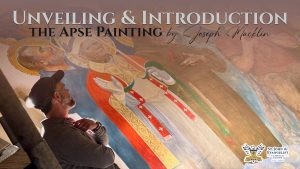
Watch the Apse Painting Introduction
Listen to the Apse Painting Introduction
The Cosmological Vision of Holy Mass is a sacred artistic work that invites the faithful into a deeper awareness of the mystery they enter every time they celebrate the Holy Mass. As reflected by Father Chas, this artwork reveals the Mass as a timeless encounter—where the sacrifice of Christ, the worship of heaven, and the life of the Church are made present all at once.
Through rich symbolism rooted in Scripture and tradition, the work portrays the Trinity, the Paschal Mystery, and the Wedding Feast of the Lamb, reminding us that the Mass is not merely a gathering, but a participation in the eternal realities of salvation. This piece serves as both catechesis and contemplation, drawing hearts and minds toward the beauty and glory of God.
Read the Apse Painting Introduction
Father Chas: Holy Mass allows us to enter into something much bigger and, you know, more profound than simply gathering to sing some songs or listen to a sermon as edifying and spirit-filled that may truly be, right? Some of our most moving moments with the Lord are during those times. But the Divine Liturgy, or the Holy Mass, is an actual participation in the mysteries of salvation by which, you know, the eternal dimension unfolds.
Father Chas: shown up there at the wedding feast of the Lamb. And at the same time, the historical dimension of the Paschal mystery are made present to us in real time. There’s a timelessness when we walk through those doors. There’s a timelessness here. And so Joseph’s sacred art is meant to make us more palpably aware of these supernatural realities to which we are joined when we celebrate Mass.
Father Chas: In the liturgy of the word, it’s a living word that makes present to us the sacred mysteries. In the liturgy of the Eucharist, we’re brought to Golgotha on Good Friday. And simultaneously, before the heavenly throne and the marriage chamber of the Lamb in heaven. We join Mother Mary and St. John at the foot of the cross. And concurrently, we join the angels and the saints in heaven.
Father Chas: In adoration of the lamb of god holy mass is the portal by which heaven and earth meet, right? And so again our hope is is that uh this piece which is entitled actually Together those two pieces The wedding feast of the lamb and the paschal mystery together Are entitled the cosmological vision of holy mass, right? Because there’s something cosmic here that takes in all of creation so, uh
Father Chas: That’s what I kind of want to, as promised, give you a little bit of a primer on the theological significance of this work. And then you’ll have the opportunity to ask Joseph himself during the Q&A immediately after this Mass. Then we’ll have the opportunity after that Q&A to be able to take a closer look
Father Chas: at this masterpiece. By coming into the sanctuary, we’ll do a little loop like this. That staggers folks. We’ll also have a little mimosa toast over at the Paris Center afterwards. But that reception will hopefully allow things to kind of move through and then feel free to come in and out between the two buildings as you see fit, so.
Father Chas: So first and foremost, we see the mystery of the Trinity.
Father Chas: being portrayed here in the traditional symbols that we have of Father, Son, and Holy Spirit. If you look up right at the very apex, you have the Father’s hand of blessing, right? That Father’s hand of blessing, the manus Dei, the hand of God. It symbolizes God the Father’s providence, his power, and his personal involvement, and blessing of approval as well, right? Right?
Father Chas: and his care for his creation. So in 1 Peter it says, Humble yourselves therefore under the mighty hand of God that he may exalt you in due time. Do you notice that Jesus himself, the son, heeds those words in a way in par excellence, right? He humbled himself under the mighty hand of God and he was exalted in due time.
Father Chas: And if you look at the hand of blessing, do you see that orb up there, that light, circular? Notice where that orb appears in the lower part. Do you see it? It’s around the cross. It’s the Father’s hand of blessing upon the very truth of that verse. Humble yourself and you will be exalted. And it happens through the obedience of God.
Father Chas: Of his son. So the triangle also represents God the father. Represents the trinity. With the co-equal sides of a triangle. Right? It represents the trinity. Three co-equal persons. And yet united together. And this reminds us of what’s in the trinity. Right? Of the nature of who God is. The catechism says. God has revealed his innermost secret.
Father Chas: You know what God’s innermost secret is? It’s not a secret anymore because of Jesus, right? It says God himself is an eternal exchange of love, Father, Son, and Spirit. And he has destined us to share in that exchange, that eternal exchange of love. That’s what the Catechism 221 says.
Father Chas: That’s the innermost secret of who God is, that he’s a relationship of persons, an eternal exchange of love. Now, son, the son is obviously symbolized by the lamb. Remember John the Baptist in John 1.29, behold the lamb of God who takes away the sins of the world. He takes away all these horrible ways that we treat one another and the way we disregard God. He’s come to make all of that right.
Father Chas: Behold the Lamb of God, and he does it through the holy sacrifice of himself, right? As 1 Corinthians mentions, for Christ, our Passover lamb has been sacrificed. We won’t go into the entire way that Jesus is the Passover lamb, the definitive Passover lamb. That’s why sacrifices ended in the temple after him, right? Right?
Father Chas: And of course, Revelation mentions Jesus as the Lamb of God 28 times.
Father Chas: At least 28 times. And there are passages here that we could go on for a long time just looking into that mystery. But because the book of Revelation was written by the apostle John, John the evangelist, that’s why he’s the central motif here. Because the Lamb of God and the wedding feast of the Lamb is also the central motif by which heaven is described to us in the book of Revelation.
Father Chas: Now, the third person, the Holy Spirit, obviously the dove, you can see there, in between the hand of God and the Lamb is the Holy Spirit. So after Jesus was baptized, remember, it said there, Behold, the heavens were opened, and he saw the Spirit of God descending like a dove, hovering. It reminds us of the recreation of the world, because where was the Holy Spirit hovering? Here.
Father Chas: Originally over the waters when he created the universe. So this is the recreation of humanity by the new Adam, Jesus. So then you have four living creatures around the throne. The blue guys up there. So you see those four living creatures, that’s a reference to Revelation. And these are the angelic beings who worship God without ceasing.
Father Chas: And they have distinct faces that tradition would eventually associate the four gospel writers to those four living creatures, right? Lion represents God’s strength and royalty. So he was eventually associated with the gospel of Mark. The ox represents God’s sacrificial service, right? Right?
Father Chas: And that would represent eventually the Gospel of Luke. Then man represents God’s humanity, his compassion. It’s a balance to the eagle, which represents God’s divinity and sovereignty. And so man represents the Gospel of Matthew, and then the eagle represents the Gospel of John, whose theology soared above the synoptic Gospels.
Father Chas: And, you know, St. Irenaeus of the second century had them associated with these four evangelists. So then you have the number seven is replete here because the number seven is very important in the book of Revelation. It’s the number of completeness or wholeness or fulfillment. This is the fulfillment of all things, right? And so in Revelation, you see the gradual fulfillment of all things.
Father Chas: And so the seven seals, if you notice there’s seven, whoops, yikes. Could you get that server? One of the server, thank you. I am too animated up here. So you see the seven, there’s seven trumpets of angels in the side that you can’t see right now. Oh, thank you. And then you have seven seals up there like Jesus is standing on a book.
Father Chas: the word right and remember in revelation there’s a scroll that nobody could open except the lamb of god and so you see the seven seals that only jesus was able to open and that gets the ball rolling in the fulfillment of all things then comes the seven trumpets right then the seven bowls and then
Father Chas: You know, it’s not good news for everybody, but it’s good news for those who remain faithful in the time of great distress, it says in Revelation. So, but that’s Jesus making all things right. And so a beautiful depiction here. You’ll see seven blue angels, three on the right and four on the left, all holding their trumpets.
Father Chas: so those are the divine messengers who announce god’s warning and divine judgment so then you have three archangels uh saint michael uh saint raphael on the right and saint gabriel on the left so saint michael look he’s got on his left hand he’s got uh god’s justice with the scales but on the right even much bigger is god’s mercy in the cross
Father Chas: And that is what tips the scales for us, thank goodness, right? And so, and then on the left, you see the blood of the lamb flowing into the chalice. And Joseph said that the…
Father Chas: depiction of my bald Filipino head would be would be small enough that we wouldn’t see it but then everybody started noticing it especially after that WILX thing but that’s actually there’s a reflection of me in there just to get that out of the way but look at the the precious blood flowing into the chalice there and so Saint Gabriel was
Father Chas: carries that it says the accuser of our brothers is cast out they cut and that’s they it refers to us they conquered him by the blood of the lamb conquered the accuser satan right and so uh in him we have redemption through his blood the forgiveness of sins in accordance with the riches of god’s grace all right so the blood of jesus his son purifies us from all sin uh john tells us
Father Chas: And of course, he says, this is the blood of the covenant, which is poured out for the forgiveness of sins. That’s what Jesus says at the Last Supper. And then St. Raphael carries the seven torches or lampstands that symbolize the seven spirits of God, which is, remember, seven is a number of perfections. So the Holy Spirit, there’s one Holy Spirit that captures that perfection.
Father Chas: then you have the 24 Saints 12 men 12 women 12 on the left 12 on the right and those were chosen um we did a vote for the parishioners favorite we wanted to find out what what parishioners uh their favorite Saints were and so everybody one Sunday got to contribute what their favorite Saint was and Saint Michael by far got the most votes
Father Chas: This is too long of a story to do to a homily. So I’m going to save that. If you want to know more, you’ll have to ask that during the interview. And so we’ll skip the whole saints part. And we’ll go to the setting of the Paschal Mystery. If you notice, look at the setting. Does that look like Galilee or Jerusalem to you? No. No.
Father Chas: it’s Jackson Michigan right it’s it’s characteristic features of Jackson and a number of the churches uh represented in that little to the right of Saint John you’ll see some steeples those are a characteristic group representative group of a lot of the churches in the diocese of Lansing to the right of that is the Saint Mary’s Cathedral itself and then up on the hill is of course the facade of our church Saint John the mother church of Jackson
Father Chas: right so but if you notice in great works of art the setting in the background of jesus’s saving mysteries are not jerusalem or galilee oftentimes but they have buildings and familiar landmarks of the artist’s era and region right take uh if you’ve been to the sistine chapel a number of our parishioners have gone there because we were there for you know the uh the jubilee year
Father Chas: If you notice some of the events of the life of Moses or Jesus, the background of Jesus’ handing of the keys to Peter, what you see in the background are Florentine buildings and Roman landmarks, right? Right?
Father Chas: And what is the reason for that? Well, the sacred mysteries of Jesus are timeless. They’re for all people, and they apply to all times, right? The sacraments and the sacred mysteries of Jesus are relevant and apply to us now in our time and place just as much as they apply to the people in ancient Israel.
Father Chas: right these saving mysteries apply to you and me just as much as they did to Saint Mary Magdalene and to our beloved patron Saint John right and so that’s why you see the Jackson County building up there you see Jackson City Hall up there you’ll see the Blake building up there you’ll see over get this in that small little area to the left
Father Chas: In that little representation of downtown Jackson. On the buildings there are over 20 bright walls murals. So that’s something that you’ll only be able to see when you come up here. And barely see that for that matter. So the other thing that I want you. The last thing about being able to read this. The theological significance of this. Is this passage.
Father Chas: method of continuous narrative. So what is that? What Joe has done here in just one landscape, right, it allows the viewer to read the story in a single image or setting, which is characteristic of some of, like, Gothic and Renaissance work, right, where you’ll see the central figure multiple times in the same landscape.
Father Chas: Events of the Life of Moses by Botticelli is one of those examples where you’ll see the events of Moses in different places on the same piece of art. And so Jesus is represented here on this same landscape because what we have here, right, is on the left you see Holy Thursday. In the middle you see Good Friday. And on the right you see Easter. There’s that Holy Triduum right there.
Father Chas: But really, throughout it, it’s Holy Week because there are, Jesus is not represented just three times here. He’s actually represented, and you can play Where’s Waldo? Instead of Where’s Waldo, you can play Where’s Jesus when you come up here. Because he’s represented like ten times. Because Palm Sunday is up there. Mass of the Last Supper is up there. The betrayal of Judas is up there.
Father Chas: The agony in the garden is up there. And just in the streets of Jackson alone, that little area on the left, you’ll see that various stations of the cross, like five different stations of the cross or moments of Jesus’ passion that leads up to what you see right in the middle, the crucifixion. And there you see all kinds of neat little things. So we’ll skip that.
Father Chas: And then we’ll end with this because there’s got to be, I’m sure there’s, the richness of this is unreal, right? Like any great work, you can unpack it for a long, long time. And so I’m going to allow you to take a closer look first and hear from Joe himself after mass, but know that the whole reason for it,
Father Chas: is to draw us closer to what we are about to do right now in the liturgy of the Eucharist. It’s a real-time participation in all of this. And so when I, you know…
Father Chas: and i in being ad orientum today i get to hold up and say and look with you instead of looking at you guys uh i get to glorify the lord and face the direction in our worship today and i will raise that up and i say i’ll say behold the lamb of god and i’ll see the representation of the lamb of god on the cross simultaneously with the lamb of god in the eternal wedding feast of the lamb
Father Chas: He’s the new temple from which living waters flow.
Father Chas: And that’s why you see the whole cosmos here underneath with, you’ll see a buck and a doe. You’ll see waters flowing from the cross, giving life to all living things. You see a peacock, a duck, a little frog over here, some turtles on the left. You’ll even see a Petoskey stone over there on the right. And there is the state tree. I think it’s like a white cedar or a white pine or something like that. But…
Father Chas: It’s there, it’s all there. That’s why it’s the cosmological vision of Holy Mass, all right? And so I’ll end with this passage of which Jesus, the new covenant, the new temple. Remember he said, destroy this temple and in three days I will raise it up. He’s talking about the temple of his. Yes. And so envision that Jesus is the fulfillment of the temple in this vision of Ezekiel, the Old Testament prophet.
Father Chas: he said to me this water flows out into the eastern district and runs down into the araba and empties into the polluted waters of the sea to freshen them wherever it flows the river teems with every kind of living creature fish will abound where these waters flow they refresh everything lives where the river goes
Father Chas: Along each bank of the river, every kind of fruit tree will grow. Their leaves will not wither, nor will their fruit fail. Every month they will bear fresh fruit because the waters of the river flow out from the sanctuary. What does Jesus command us to do? Go and bear much fruit. Receive him from here and bear much fruit out there.