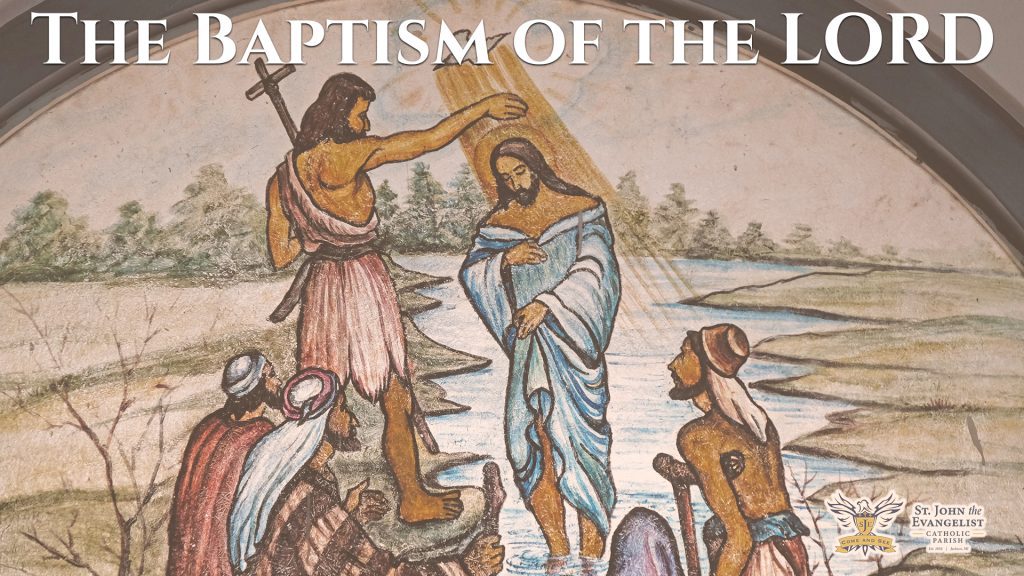
To baptize means to dunk, drown, submerse, wash. John’s baptism was something new; there were lots of Jewish washing rituals and rites, but his was so unique that St. John became known as “the Baptizer.” He took the practice of mikvah (mick-VEH; a Jewish bathing ritual) away from the temple and took it out to the desert wilderness, away from priests and religious authorities. Normally, a practicing Jew would become ritually and legally “clean” through the water. But John made his washing into an initiation for repentance. It was an outward sign that the person was choosing to change directions in the moral life. When Jesus came to his cousin along with multitudes of people, he did not need to be forgiven of sin or to repent, but rather Jesus gave the future baptismal waters the power of sacramental forgiveness and he made the water holy. Jesus united himself to us sinners through the water. He humbled himself, lowered himself, emptied himself. He did not need baptism for himself.
This takes place at the Jordan River—the great river which begins at Mt. Hermon way to the north. One tributary of the headwaters was at Caesarea Phillipi. The Jordan flows into the Sea of Galilee then continues south to the Dead Sea. It is murky, slow moving, unimpressive overall. From bank to bank it’s seldom wider than 100 feet across. The depth is shallow, no more than 10 feet deep. It carries salt deposits, silt, and mud from the north as a cloudy, dirty, uninviting body of water. The river descends to almost 1,300 feet below sea level as it empties into the Dead Sea. It is the lowest geographical spot on earth.
The very site where St. John was baptizing was the very same spot where Joshua led the children of Israel across the parted waters of the Jordan River as they crossed into the Promised Land of Canaan toward Jericho. This was the location where Elijah was assumed into heaven on the bank across from Jericho, and Elisha watched him carried away in a chariot of fire. The Syrian (Gentile) General Naaman was healed of leprosy by the prophet Elisha after washing in the waters of this same place. Naaman not only received the gift of healing but the gift of faith in Yahweh as the one true God.
So in this very unimpressive location of the lowest of lows, we have seen the washing away of leprosy—which is often a symbol for sin. We have heaven’s doors parting open—connecting heaven and earth. We have the entrance into the Holy Land—which is an image of heaven. This is the same location where John baptizes Jesus, and the stage is set for the Sacrament of Baptism that washes away sin, opens heaven, and prepares us for the eternal Holy Land.
John the Baptizer himself said in John’s Gospel that his ritual mikvah is merely water, but that one is going to follow who will “baptize with spirit and fire!” To baptize with water is to wash clean. Water is an outward temporary washing; John’s baptism is merely a baptism with water. It is only a sign. But Jesus will follow with a Sacramental baptism of spirit and fire. Fire will purify the pure but wipe out the wicked. It burns away garbage but perfects gold. Like in metal smelting, the pure element gets purer while the impurities are burned away. When the disciples of Jesus baptize, it is far more than just a sign: it is a Sacrament. An outward ritual that impacts the soul; power that flows from Jesus to bring inward grace.
For the onlookers that day who shared the Jordan’s waters with Jesus, it probably looked like this thirty-year-old carpenter was just another sinner being baptized; but St. Paul will say through the waters of baptism we are being baptized into Christ’s death and resurrection. We die with him so we can rise with him.
St. Matthew gives us a power-punch with the audible words heard from God the Father; phrases that all good Jews would have known well. “You are my son” is from Psalm 2:7 a royal Psalm about the Messiah being the son of God. “Whom I love” is from Genesis 22:2 where Abraham is told “take your son your only son whom you love, Isaac, and go to the region of Moriah.” And the phrase “With you, I am well pleased” comes from Isaiah 42:1, where the Suffering Servant is “my chosen one in whom I delight…” Clearly this moment in the murky Jordan is not a typical cleansing ritual. When Jesus sends his disciples out to baptize with the power of the Trinity, their New Covenant mikvah was so unique that Baptism becomes the initiation Sacrament for all Christians.
Pope Benedict XVI says Jesus entered solidarity with us sinners. Jesus became one with us, walked with us, lived life with us, and then died with us. The unification begins in the waters of Baptism.