
Beauty – I think that is ultimately what we all yearn for as human beings. It is great when we find it, but unfortunately the pleasure in obtaining it dissipates all too soon, and we are on to the next best thing. Coincidingly, beautiful things lose their splendor to the corrupting progression of time, even if our desire for them remains. If only there was something – or someone – that is unceasingly satiating and qualitatively perfect.
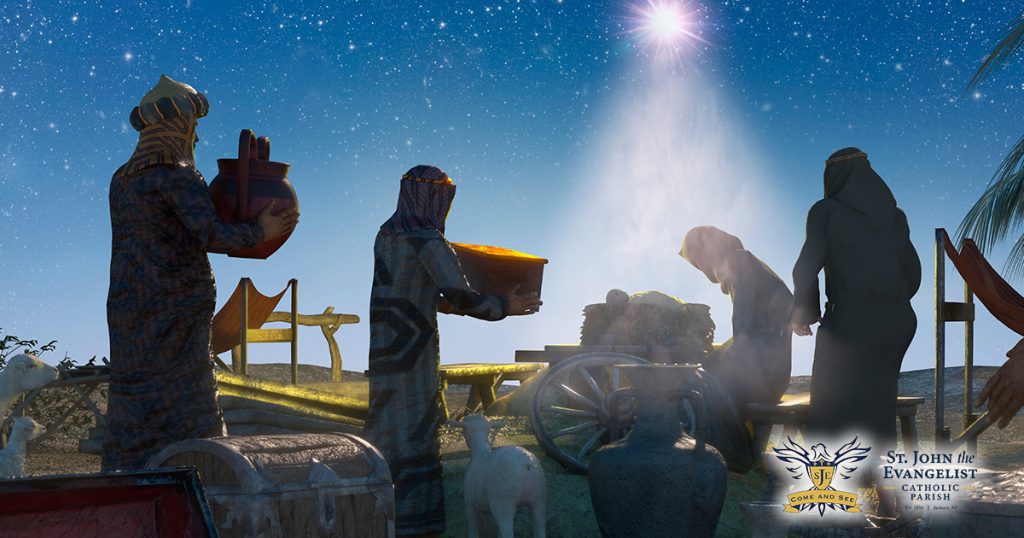
Today we celebrate the Epiphany, or Christ’s Revelation to the Gentiles. Saint Matthew writes of the Bethlehem star, which was appropriate for this revelation: its splendor was uniquely its own, and yet it signaled an even greater beauty. As Matthew 2 goes, the star delivered the Magi to the Newborn King of the Jews. The Magi were familiar with Isaiah’s prophecy due to Persia’s conquest of Judah in 539 BC; hence, they correctly discerned the star’s meaning and brought gifts. Christ was gifted gold, myrrh, and frankincense: gold, of course, is fit for kings; myrrh, a burial ointment, foreshadows Christ’s suffering, death and burial; lastly, frankincense signifies divinity and is used for worship. Signs like the star and gifts attract us with their proper beauty, but they direct us to a higher beauty in the Christo-allegorical sense.
The Church has always emphasized the power of beauty to draw us closer to God, especially through art. With our new apse mural by Joseph Macklin, we as a parish can be reminded of Heaven’s beauty every time we attend Mass, which itself is heavenly and holy! The mural depicts Christ’s Paschal Mystery with scenes of the Last Supper all the way to The Lamb of God from Revelation. The Life of Christ is profound in this way, that the source of truth, goodness and beauty, through Whom all things were made, became man. By taking on human nature, Christ redeems all dimensions of humanity, including our desire for beauty and fulfillment. St. Pope John Paul II, a true philosopher at heart, wrote well of this: he affirmed fulfillment is when man deliberately knows, wills, and actually obtains a good. Certainly then, fulfillment in absolute terms can only be eternal life with Christ, since that is our ultimate end.
A great articulation of this ontological reality comes from the story of Jesus and the Samaritan woman at the well. Responding to the woman’s question on how He was going to drink without a bucket, Jesus said: “Everyone who drinks this water will be thirsty again; but whoever drinks the water I shall give will never thirst; the water I shall give will become in him a spring of water welling up to eternal life” (Jn 4:13-14). Jesus tells us that all who thirst in vain can find eternal satisfaction and delight in Him. Not too long ago the Church celebrated Gaudete Sunday – the Third Sunday of Advent focused on joy. Per St. Thomas Aquinas, joy is the effect of the lover enjoined to the beloved. Makes sense considering Christmas is when Christ enjoined Himself to the world! Christ is the only One who can satisfy us because we were made for Him; He is the only object capable of giving eternal joy since He Himself is the source of love, joy, truth, goodness and beauty!
This Epiphany, let us take delight in Jesus Christ as much as we can. Let us give adherence to God in faith and share in His beauty, truth and goodness. As Matthew writes, “[the magi] were overjoyed at seeing the star, and on entering the house they saw the child with Mary His mother.” (Mt.2:20-11). We, too, can share in their joy when we receive Christ in the sacraments, worship Him at Mass, speak to Him in prayer, and recognize Him in the faces of the needy, all while anticipating His Second Coming. Once we have this joy for ourselves, we are empowered to evangelize and share it in word and deed. Lastly, like the Magi, let us bring to Him our gifts so He may use them to build up His Church.