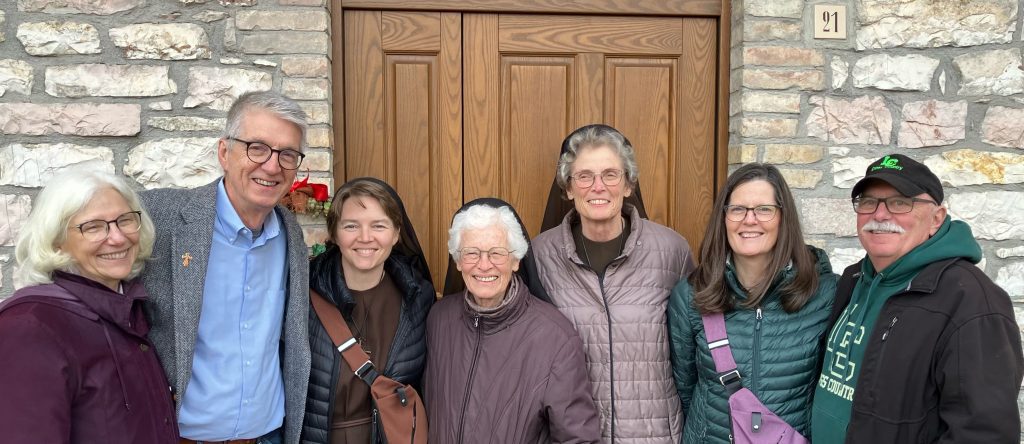
In early December, instead of “decking our halls with boughs of holly,” Marcia and I were in flight to Rome for a Jubilee Year pilgrimage to Assisi and Rome. We were led by Sister Faith Marie Woolsey, FSE, daughter of parishioners Mike and Ellen Woolsey, and fellow Franciscan Sisters from Assisi and Rome. And truly, the pilgrimage far exceeded all of our expectations. I still find myself musing upon and unpacking the experiences and events.
In Assisi we stayed in the heart of the town at Casa Madonna della Pace (Our Lady of Peace House), a “pensione” (guesthouse) operated by the Franciscan Sisters of Alcantarine. We were within walking distance to San Rufino Cathedral, St. Mary Major, and the basilicas of St. Francis and St. Clare. Each morning as we trod up and down the narrow cobblestone “roads” to the holy sites, we quickly learned to move aside to safety, making room for the pop-can-sized Fiats, motor scooters, and eBikes to pass.
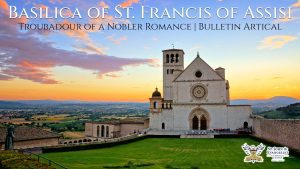
It is hard to think of Assisi without St. Francis coming to mind. Even so, despite the highly prominent role of St. Francis in our faith tradition, and his widespread recognition even among those who are not Catholic, I must admit that I have not given due diligence to the study, devotion, and appreciation of this profound, yet humble deacon from the little Umbrian town on the spur of Monte Subasio.
When considering Francis’ background and family life, it is difficult to imagine the outcome of his radical transformation. His father was a wealthy cloth merchant, and quite naturally Francis delighted in fine clothes. He was handsome, courteous, and a favorite among the young nobles of Assisi, attending the school of Troubadours (lyric poets and poet-musicians whose major theme was courtly love).
Francis’ conversion began during the Assisi and Perugia war in which he fought. He was captured, imprisoned, and suffered a serious illness. From that point his life radically changed, as G.K. Chesterton poetically describes in his biography of Francis:
“He [Francis] flung himself into fasting and vigil exactly as he had flung himself furiously into battle… He devoured fasting as a man devours food. He plunged after poverty as men have dug madly for gold. And it is precisely the positive and passionate quality of this part of his personality that is a challenge to the modern mind in the whole problem of the pursuit of pleasure.”
It is well known that Francis publicly renounced his family inheritance by stripping himself naked and returning his clothes to his father. From that point his rule of life became radical poverty, perfect joy, love for God and all creation, and living the Gospel literally without compromise.
In Assisi we gazed upon the crucifix from which Francis heard the voice of the Lord say, “Rebuild my Church.” We climbed into the claustrophobic “retreat caves” where Francis would spend days in prayer and fasting. Gradually, I came to the realization that I had been maintaining a distance from Francis—not because I feared his intellectual faith, but his radical lifestyle. My reasoning, or excuse, has been that, with one eye closed, I had partially accepted a sentimental and “morning star of the Renaissance” reading of Francis.
In the foreword to Chesterton’s biography of St. Francis, Joseph Girzone wrote the following sobering words:
“We make statues of St. Francis and recite his prayer of peace. Our frightened world desperately grabs hold of his memory in a frantic attempt to protect our environment from pollution, but we don’t really take him seriously. We have merely adopted him as a pet or mascot without ever grasping the meaning of his life.”
On January 10, Pope Leo proclaimed a Franciscan Jubilee Year to commemorate the 800th anniversary of Francis’ death—a gift for the entire Church and an occasion for authentic spiritual renewal (link below).
St. Francis, pray for us and take us deeper into the love of Christ, O “Troubadour of a Nobler Romance.”
God bless,
+Dcn Dave