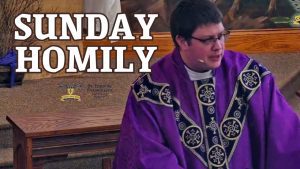
Father Randy Koenigsknecht
Watch the Homily
Listen to the Homily
A powerful reflection on the raising of Lazarus, exploring grief, faith, and how Jesus brings life to the dead places in our hearts. Discover how hope overcomes even death.
Read the Homily
This gospel that we just heard is very raw. It is packed with emotion and filled with the reality of the human experience—suffering, grief, and death. These are things every one of us can relate to.
This past week during the Rescue Project, a question was asked that stayed with me: Have you ever buried someone you love? If you haven’t, you will. That reality is unavoidable. The one certainty in life is that death will come—for ourselves and for those we love.
As someone with a large family, and as a priest, I know I will one day stand at many funerals for people I deeply love. That reality is overwhelming. And the truth is, I cannot make sense of it apart from Jesus.
Only Jesus can make sense of death, suffering, and the deepest fears of our hearts.
In the Gospel, we encounter this very reality through Martha, Mary, and Lazarus—three people Jesus deeply loved. When Lazarus becomes sick and dies, Jesus does something unexpected—He waits. By the time He arrives, Lazarus has already been dead for four days.
From a human perspective, death is final. It is separation. It is loss. But from Jesus’ perspective, death is not the end—it is like waking someone from sleep.
When Jesus arrives, Martha meets Him with a question many of us have asked:
“Lord, if you had been here, my brother would not have died.”
We’ve all felt that.
Lord, where were you? Why didn’t you show up? Why did this happen?
Jesus responds not with an explanation, but with a declaration:
“I am the resurrection and the life. Whoever believes in me, even if he dies, will live.”
He asks her a question that echoes into our own lives:
Do you believe this?
Martha chooses faith.
Then Mary comes. She carries the same grief, the same question—but Jesus responds differently. Instead of words, He weeps.
“Jesus wept.”
God is not indifferent to our suffering. He enters into it. He shares our pain. He walks with us in it.
Standing at the tomb, Jesus commands the stone to be rolled away. Even then, there is hesitation—because the reality of death feels too final. But Jesus calls out:
“Lazarus, come out.”
And Lazarus walks out of the tomb.
This miracle is not just about physical life—it is a sign of something deeper. Death no longer has the final word.
And that raises a powerful question for us:
If Jesus can raise a man who has been dead for four days… what can He do with us right now?
What about the places in our lives that feel dead—our struggles, our failures, our wounds, our sin, our shame?
We often believe that those parts of us can never change. That we are stuck. That dead things stay dead.
But Jesus came to change that.
The prophet Ezekiel speaks of a valley of dry bones—completely lifeless. And God asks:
Do you believe these bones can live again?
That same question is asked of us.
Do you believe God can bring life to the dead places in your heart?
Faith sometimes looks like Martha—bold and trusting.
Other times it looks like simply saying:
Lord, I want to believe. Help my unbelief.
Taking a step toward Jesus often means change. It means opening our hearts, even when it’s uncomfortable. It means rolling the stone away—especially in moments like confession—where we bring our brokenness to Him.
And when we do, He brings life.
The Holy Spirit dwells within us to renew us, strengthen us, and restore what feels lost.
Because this is what God does.
He brings the dead back to life.
So today we pray:
Lord, I believe. Bring me to life.