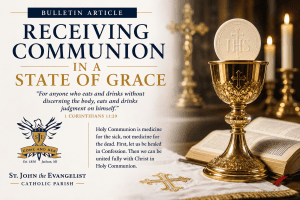
Receiving Communion in a State of Grace
In our Tuesday Bible Study, we’ve been digging deep into 1 Corinthians. In Chapter 11 St. Paul writes to correct the people in the Church at Corinth. They have had a practice of celebrating the Eucharist after a big potluck meal, it was called the Agape Meal or the Love Feast. Some of the more wealthy members were becoming exclusionary and not showing Christian love to the poor. Some of them were being gluttonous and getting drunk—while others went hungry and ignored. They embarrassed and shamed some members of the Body of Christ. Paul says: think about what you are doing, examine your actions, and if you are guilty don’t receive Holy Communion!
In 1 Corinthians 11:27 he writes, “Whoever eats this bread and drinks this cup of the Lord in an unworthy manner will be guilty of the body and blood of the Lord.” Then in verse 29 he adds, “For anyone who eats and drinks without discerning the body, eats and drinks judgment on himself.” The immediate context is that Paul is telling them: unless you get your act together with the Lord’s Supper and treat each other like the Body of Christ, don’t you dare receive Communion together; because you are not in communion with each other.
Ever since the Council of Trent in the 1500s, theologians have expanded the specific sense of this particular situation. The Church teaches today that if we are in a state of mortal sin we would be receiving unworthily. The Catechism states:
“Anyone conscious of a grave sin must receive the sacrament of Reconciliation before coming to Communion.” (CCC 1385)
In that sense, we need to be worthy to receive Jesus.
Quite honestly, I went through a time when I did not understand this. The Council of Trent declared that no person should receive Holy Communion in a state of mortal sin without first making a sacramental confession, no matter how contrite they may feel. I really felt like the Council had gone beyond what Paul was saying. He was writing about abuses during the Agape Meal—he doesn’t specifically mention every other sin. And the question many of us ask is: Who can possibly be worthy enough to receive the Eucharist?
I knew enough about Church history to know that this teaching eventually contributed to a very destructive heresy: Jansenism, a harsh and fearful Catholic puritanism. For almost 300 years many people were afraid to receive Communion because they believed they would be condemned for being unworthy. Dutch theologian Cornelius Jansen taught that human sin had corrupted us so completely that we had effectively lost our free will. This produced a fearful understanding of Jesus—a “hell and brimstone” faith that emphasized God’s wrath while minimizing His mercy. Confession and the Eucharist became viewed as rewards for the spiritually elite rather than gifts of grace, leading many people away from both sacraments.
As I wrestled with this several years ago, I realized there has been a lively debate about this teaching for centuries. I found myself among many who questioned it. Then Pope Francis added another perspective. He frequently reminded us that the Communion line is meant to be a place of healing, not an exclusionary reward for the perfect. He often described the Eucharist as medicine for those who are spiritually sick.
That gave me pause.
After spending a great deal of time in prayer, God slowly began changing my perspective. If we are temples of the Holy Spirit, and if we receive Communion while knowingly remaining in mortal sin, then our spiritual house is divided against itself. I kept remembering what happened when Uzzah reached out to steady the Ark of the Covenant. Though his intentions may have seemed good, he touched what was holy without reverence, and God struck him dead instantly (2 Samuel 6:6–7). I couldn’t help but think: Jesus in the Eucharist is infinitely holier than the Ark.
I also remember hearing this explained—perhaps by Fr. Chas or Fr. Brian—in terms of marriage. Jesus is the Bridegroom and the Church is His Bride. In Holy Communion we receive Him into our very bodies. If I have knowingly turned away from Christ through serious sin, then expecting Eucharistic intimacy without seeking reconciliation would be like rejecting my spouse and then expecting the closeness of marriage without ever apologizing or attempting to repair the relationship. At the very least, reconciliation must come first.
That image changed everything for me.
I realized that St. Paul was saying we should not receive Communion with the Body of Christ (the Eucharist) if we have broken communion with the Body of Christ (the Church). The whole point of the Eucharist is union. If I have freely broken that union through serious, deliberate sin, then the first step is reconciliation.
When we commit mortal sin—a grave sin committed knowingly and freely—we spiritually separate ourselves from the God of Life. Scripture describes this as spiritual death.
As Fr. Mike Schmitz puts it so well:
“Holy Communion is medicine for the sick, not medicine for the dead.”
The spiritually dead first need to be restored to life through Jesus Christ. The ordinary means He has given us for that restoration is the Sacrament of Reconciliation.
Now it finally makes sense to me.
My friends, let’s all make Confession a regular part of our spiritual lives. Jesus is waiting there with mercy, healing, and the grace to restore our communion with Him.