Father Chas Canoy
Watch the Episode 3
Listen to the Episode 3
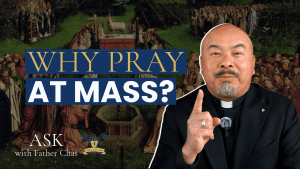
If the Mass is one prayer, why does the priest invite us to pray after the Gloria? In this episode of Ask Father Chas, we explore the meaning of the Collect, how our personal intentions become part of the prayer of the Church, and why the Holy Mass is both one prayer and a collection of many prayers united in Christ’s perfect sacrifice.
Read the Episode 3
If the Mass is one prayer, why are we invited to pray partway through the Mass after the Gloria? They say, “Let us pray.”
You are correct when you say that Holy Mass is one prayer. In fact, it is the greatest prayer there is because it is an actual participation in Jesus’ supreme offering of Himself on the Cross that He made once and for all. There is a timelessness to Holy Mass in that we are brought to the original Holy Thursday at the Last Supper and made present at the foot of the Cross on Good Friday on Mount Calvary.
Mass is the supreme prayer because Jesus, the Lamb of God, is the Holy Sacrifice of the Mass that is on that altar. But within that supreme prayer of the Mass are a number of prayers that include our own personal prayers.
For example, each of us is called to bring to God at Mass our own prayer intentions. So when the priest says, “Let us pray,” right after the Gloria, there is supposed to be a brief moment of silence when we recall all those personal intentions for which we want to pray.
Then the priest recites the Collect, spelled C-O-L-L-E-C-T. It is pronounced “collect” because in that prayer the priest is meant to collect all those personal intentions that the people are offering in the silence of their hearts and unite them into the one prayer, the Collect, that begins the Liturgy of the Word.
Hopefully that makes sense. The prayer that is the Mass is a collection of prayers. Think of the Universal Prayer. It is actually called the Prayer of the Faithful—singular prayer, not Prayers of the Faithful—because even though it is composed of many different petitions, it is all meant to be united as one Prayer of the Faithful.
After that, we enter into the Liturgy of the Eucharist, which includes another prayer: the Eucharistic Prayer, of which there are four main versions. Then we have the most famous prayer of them all, the Our Father.
This idea that you can call something a prayer, but within that one prayer have many prayers, is not something restricted to Holy Mass. Think about the Holy Rosary. The one prayer of the Rosary contains six Our Fathers, fifty-three Hail Marys, and six Glory Bes.
In our prayer life, we are continually bringing many prayers to mind and uniting them to the one prayer of Jesus Christ, who is, in a sense, prayer itself. He is the offering—the definitive offering to God the Father—who makes all things new.
Amen.