Father Chas Canoy
Watch the Episode 4
Listen to Episode 4
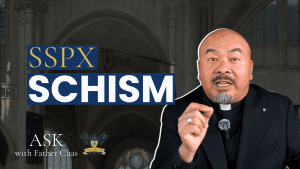
What is the Society of St. Pius X (SSPX), and why has its relationship with the Catholic Church been a source of confusion for many Catholics? In this episode of Ask Father Chas, Father Chas explains the origins of the SSPX, the reforms of the Second Vatican Council, the difference between authentic Church teaching and liturgical abuses, and how traditional forms of Catholic worship continue to thrive within the Church today. Learn about the Traditional Latin Mass, the Novus Ordo Mass, Vatican II, and what it means to remain in full communion with the Catholic Church.
Read Episode 4
I don’t completely understand the fracture with the Saint Pius Society, the SSPX folks, on how they’re trying to preserve tradition and modern Catholics are trying to supposedly kill the tradition, yet the Norvos, Orthos are their word for us. We still allow Latin Masses, we still have Latin Masses in Jackson even, they’re not hard to find. Can you talk a little bit about what their problem is besides their bishops not getting consecrated? Yes, it can be very confusing and admittedly I don’t understand the whole situation.
So for those, just a little primer for those who don’t know what the Society of Saint Pius X is, or SSPX for short, it’s a movement founded over 50 years ago in 1970 by an Archbishop Marcel Lefebvre who wanted to retain the Tridentine Mass or the traditional Latin Mass just as it was before the Second Vatican Council in 1960s. So the SSPX is not in full communion with the Catholic Church because they reject some of the doctrinal developments of Vatican II and the legitimacy and dignity of the Novus Ordo, which is the Holy Mass in its present form, after having incorporated the developments decreed by Vatican II. So that allowed the use of the vernacular language, for example, it permitted communion in the hand for the countries whose bishops asked for it, as well as the priests to turn towards the people versus populum instead of facing in the same direction as the people toward God, which is Ad Oriento.
Now where this can get confusing is that along with these developments, many priests become kind of loosey-goosey with the Mass and took on an anything-goes approach to the Divine Liturgy, and so many of the faithful were jarred and disillusioned, and they naturally thought that these other radical changes were also a result of Vatican II, but were actually deviations and abuses of what the Second Vatican Council Fathers actually decreed and envisioned. And so all of this confusion had a number of the people questioning the legitimacy of the Council Reforms, even though what people were oftentimes observing in the pews were misapplications of the actual reforms called for by the Council Fathers. So the Liturgy became so different in practice, that it lacked any of the continuity that Vatican II also wanted to maintain in the Liturgy.
And to actually read what the Council Fathers actually envisioned, you could begin with reading Vatican II’s Constitution on the Sacred Liturgy, Sacro Sanctum Concilio. So people experienced those abrupt radical changes in the 70s, and they accurately sensed something wasn’t right, but that made them susceptible to the assertions of groups like SSPX, who to this day questions the legitimacy of a number of aspects of the Second Vatican Council. In fact, just recently the Society rejected the Holy See’s proposal for theological dialogue, and SSPX said unfortunately that they will go ahead with their plans to ordain schismatic bishops later this year.
So it’s unfortunate because there are a number of good-intentioned people who want to stay faithful to the Church, but are misled by the SSPX, which has a relatively small group of bishops and priests whom they would rather believe over the full magisterium of the Church, the Official Teaching Office. Plus a lot of liturgical abuses rampant in the latter part of the 20th century have been corrected in this last generation. Thanks be to God, right? So finally, the anonymous person who asked the question is correct in pointing out how it’s not difficult to find a more traditional leaning liturgy in Jackson.
You have the Extraordinary Form of the Traditional Latin Mass celebrated each Sunday at 1 p.m. at St. Mary’s Star of the Sea. And here at St. John, our 12 p.m. Sunday Mass is celebrated with the Eucharistic Prayer in Latin, and the priest is ad orientem, meaning that during the Liturgy of the Eucharist, the priest faces east with the people. And we have worship aides in the pews that have the English translation beside the Latin Eucharistic Prayer, so that you can follow along with what the priest is saying.
And that Sunday Noon Mass is known for its sense of reverence and solemnity. But I suggest you come and experience it for yourself to see if it aids you in worshiping God more reverently and more deeply. God bless you.